Learning Open Policy Agent with Tanzu Mission Control Part-3
· 14 min read
This article is part of the Learning Open Policy Agent with Tanzu Mission Control series.
Series
Part 1 : Overview
Part 2 : Playing with TMC's Open Policy Agent
Part 3 : Dissecting TMC's Open Policy Agent < you are here
Part 4 : Writing your own OPA policies from TMC
Introduction
As shown in the overview, OPA defines policies against Kubernetes requests in a flow like this:
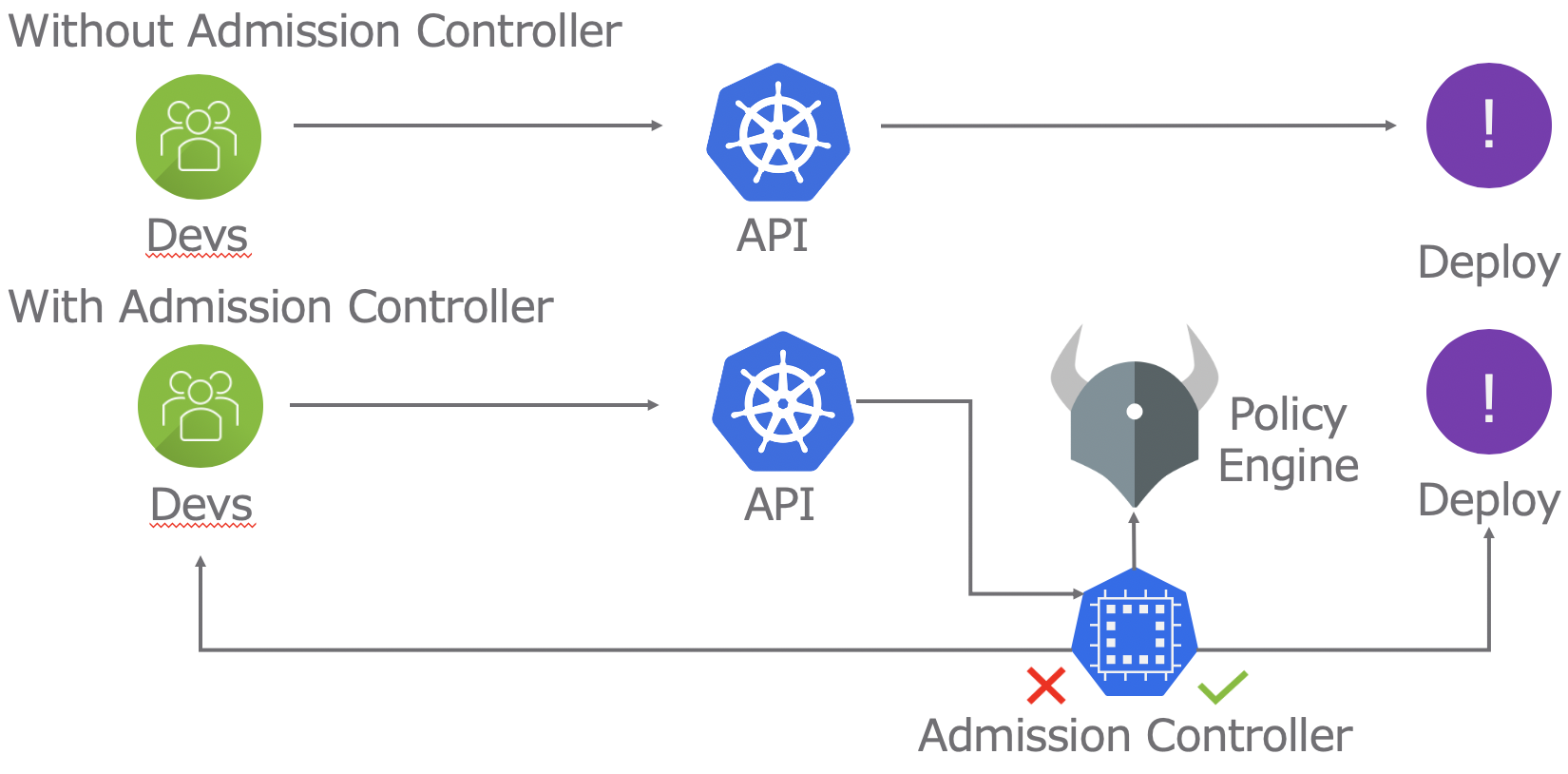
When a Security Policy is enabled from TMC, the same mechanism is at work.
Below we dissect how, with a TMC Security Policy enabled, the Pod startup in Part 2 was blocked.
This assumes an environment managed by TMC. Follow along with the "With Admission Controller" flow diagram above.
API > Admission Controller
In TMC, the following resource is defined as the Admission Controller intercepting the API:
kubectl get validatingwebhookconfigurations gatekeeper-validating-webhook-configuration
NAME                                          CREATED AT
gatekeeper-validating-webhook-configuration   2020-09-30T14:43:48Z
The validatingwebhookconfigurations resource defines the Admission Controller's behavior. For details see Dynamic Admission Control in the manual.
At the time I checked, the contents looked like this (key parts excerpted):
apiVersion: admissionregistration.k8s.io/v1
kind: ValidatingWebhookConfiguration
metadata:
  name: gatekeeper-validating-webhook-configuration
webhooks:
- admissionReviewVersions:
  - v1beta1
  clientConfig:
    service:
      name: gatekeeper-webhook-service
      namespace: gatekeeper-system
      path: /v1/admit
      port: 443
  failurePolicy: Ignore
  matchPolicy: Exact
  name: validation.gatekeeper.sh
  namespaceSelector:
    matchExpressions:
    - key: admission.gatekeeper.sh/ignore
      operator: DoesNotExist
  objectSelector: {}
  rules:
  - apiGroups:
    - '*'
    apiVersions:
    - '*'
    operations:
    - CREATE
    - UPDATE
    resources:
    - '*'
    scope: '*'
Looking at the following portion, it means the Admission Webhook fires on CREATE and UPDATE of every API and every resource:
rules:
- apiGroups:
  - '*'
  apiVersions:
  - '*'
  operations:
  - CREATE
  - UPDATE
  resources:
  - '*'
  scope: '*'
Additionally, this portion describes the webhook destination:
clientConfig:
  service:
    name: gatekeeper-webhook-service
    namespace: gatekeeper-system
    path: /v1/admit
    port: 443
In summary:
- The Admission Controller is defined by the
validatingwebhookconfigurationsresource - The Admission Webhook fires on CREATE and UPDATE of every API and every resource
- The Admission Webhook destination is
gatekeeper-webhook-service:443/v1/admitingatekeeper-system
Moving on.
Admission Controller > Policy Engine
Check the service running at the webhook destination.
You can see a service up at gatekeeper-webhook-service:443 from the previous step:
kubectl get svc -n gatekeeper-system
NAME                         TYPE        CLUSTER-IP     EXTERNAL-IP   PORT(S)   AGE
gatekeeper-webhook-service   ClusterIP   10.101.28.83   <none>        443/TCP   18h
The service's Selector is:
# kubectl get svc -n gatekeeper-system -o yaml
apiVersion: v1
items:
...
- spec:
...
    selector:
      control-plane: controller-manager
      gatekeeper.sh/operation: webhook
      gatekeeper.sh/system: "yes"
Searching by the matching labels shows three gatekeeper-controller-manager-* pods — that is, deployed in HA.
This is itself the OPA Gatekeeper — the Kubernetes-flavored OPA image.
kubectl get pods -l control-plane=controller-manager -n gatekeeper-system
NAME                                            READY   STATUS    RESTARTS   AGE
gatekeeper-controller-manager-c97765cd6-bgkjx   1/1     Running   0          18h
gatekeeper-controller-manager-c97765cd6-hnvx2   1/1     Running   0          18h
gatekeeper-controller-manager-c97765cd6-znhqk   1/1     Running   0          18h
In summary:
- At the webhook destination, OPA Gatekeeper runs in an HA configuration
Moving on.
Policy — and the Rego language
Now we finally look inside OPA. OPA has two resources:
- constrainttemplates : describes, in the Rego language, what policy to define for each resource
- constraints : defines how Constraints are imposed based on the constrainttemplates
For details see the OPA Gatekeeper Github README.
Here we trace how the following error from the Pod launch in Part 2 was produced:
[denied by tmc.cgp.strict] Sharing the host namespace is not allowed: verybad
ConstraintTemplates
The definition behind that error lives in this file:
kubectl get constrainttemplate vmware-system-tmc-block-host-namespace-v1
NAME                                        AGE
vmware-system-tmc-block-host-namespace-v1   22h
At the time I checked, the contents looked like this (key parts excerpted):
apiVersion: templates.gatekeeper.sh/v1beta1
kind: ConstraintTemplate
metadata:
  name: vmware-system-tmc-block-host-namespace-v1
spec:
  crd:
    spec:
      names:
        kind: vmware-system-tmc-block-host-namespace-v1
  targets:
  - rego: |-
      package k8spsphostnamespace
      violation[{"msg": msg, "details": {}}] {
          input_share_hostnamespace(input.review.object)
          msg := sprintf("Sharing the host namespace is not allowed: %v", [input.review.object.metadata.name])
      }
      input_share_hostnamespace(o) {
          o.spec.hostPID
      }
      input_share_hostnamespace(o) {
          o.spec.hostIPC
      }
    target: admission.k8s.gatekeeper.sh
The key part is:
- rego: |-
    package k8spsphostnamespace
    violation[{"msg": msg, "details": {}}] {
        input_share_hostnamespace(input.review.object)
        msg := sprintf("Sharing the host namespace is not allowed: %v", [input.review.object.metadata.name])
    }
    input_share_hostnamespace(o) {
        o.spec.hostPID
    }
    input_share_hostnamespace(o) {
        o.spec.hostIPC
    }
The language used here is called Rego. To understand it one level deeper, use the Rego online viewer:
https://play.openpolicyagent.org/p/EWQB9RPi3K
The link above has, as Input, the verybad.yaml from Part 2 converted through the AdmissionController.
The code pane contains the code included here.
Toggle "hostPID" in the Input between True and False and watch the Evaluate result.
When True, the Output shows:
{
    "violation": [
        {
            "details": {},
            "msg": "Sharing the host namespace is not allowed: verybad"
        }
    ]
}
When False, the Output shows:
{
    "violation": []
}
As the results show, a value goes into "violation" when "hostPID": "true".
Within it, msg matches the message we actually received.
So this Rego language is how TMC's Security Policies are defined.
Constraint
One more thing to check: the Constraint. It defines when the rule written in Rego takes effect.
It feels odd, but do a kubectl get on the ConstraintTemplate name.
You'll see this:
kubectl get vmware-system-tmc-block-host-namespace-v1
NAME             AGE
tmc.cgp.strict   23h
At the time I checked, the contents looked like this (key parts excerpted):
apiVersion: v1
items:
- apiVersion: constraints.gatekeeper.sh/v1beta1
  kind: vmware-system-tmc-block-host-namespace-v1
  metadata:
    name: tmc.cgp.strict
  spec:
    match:
      kinds:
      - apiGroups:
        - ""
        kinds:
        - Pod
      namespaceSelector:
        matchExpressions:
        - key: e2e-run
          operator: DoesNotExist
spec.match describes when this Constraint applies. This rule covers all Pod operations.
In summary:
- TMC automatically creates the ConstraintTemplates and Constraints, operating transparently to the user
How Policy Insights works
Last time I introduced Policy Insights, the impressive feature listing rule violations.
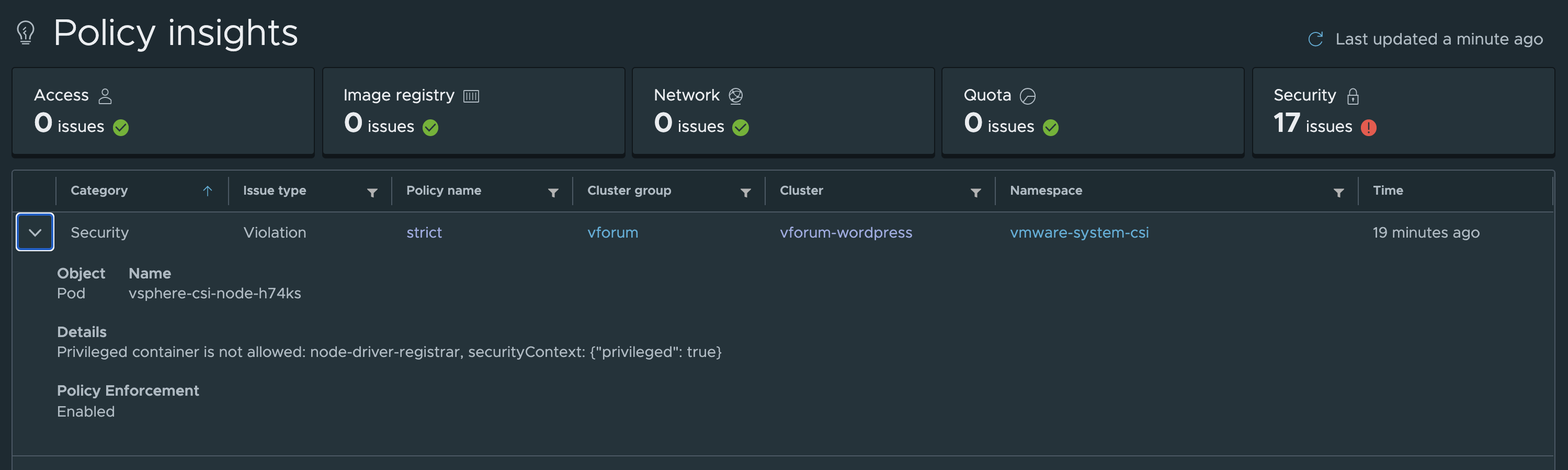
The trick behind it is OPA's Audit feature:
https://github.com/open-policy-agent/gatekeeper#audit
You can confirm this from the CLI too by inspecting the Constraint. For example, when it looks like this:
status:
  totalViolations: 1
  violations:
  - enforcementAction: dryrun
    kind: Pod
    message: 'Sharing the host namespace is not allowed: verybad'
    name: verybad
    namespace: default
The PolicyInsight side shows:

So this feature, too, is built on OPA.
Summary
- TMC's Security Policies use AdmissionController, OPA, and the ConstraintTemplate/Constraints mechanism
- ConstraintTemplates can be written in a language called Rego
- OPA is also used for the Policy Insights feature
This was planned as a three-part series, but a few days after writing this article, new features were announced. That content is covered in Part 4.